How Memily obtains consent for text messages
Memily is a private family photo and story app for iPhone. This page documents every way a person consents to text messages from Memily, with screenshots of each in-app experience, so the program can be reviewed without an account.
Messages are sent by Memily's own server through a registered Twilio Messaging Service. Memily sends two kinds of text messages, each with its own consent path, described below.
Path 1 — One-time invitations, sent at the direction of a Memily user
A signed-in Memily user opens Invite Friends in the app and selects specific people, one at a time, from their own contacts. Nothing is preselected and there is no "select all". The user reviews the invitation and taps Send. Directly above the Send button the app states the authorization the user is giving:
The user's affirmative act directs Memily to deliver a single invitation to each selected recipient. Each recipient receives exactly one message, which identifies Memily and the inviting user by name, contains one link to the invitation on memily.com, and ends with opt-out instructions. Recipients receive no further messages of this type. A recipient who replies STOP is added to a permanent suppression list. The application enforces per-recipient, per-batch, and per-day limits.
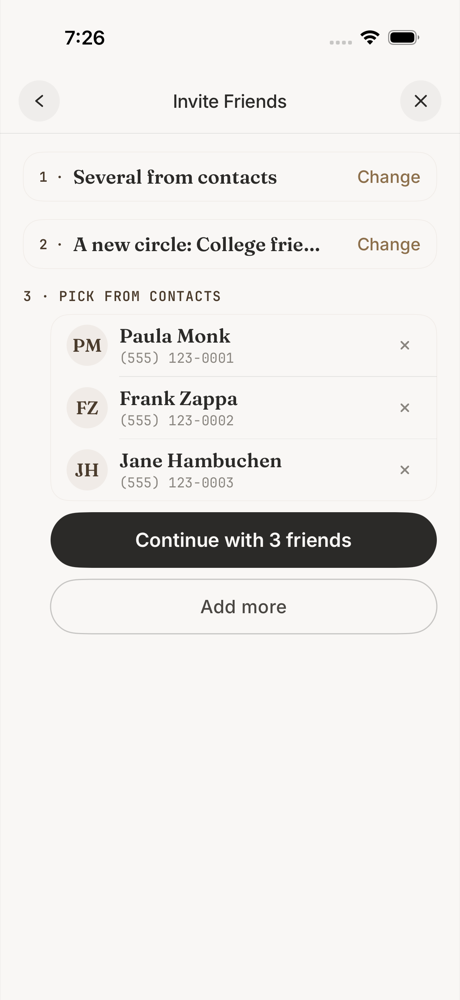
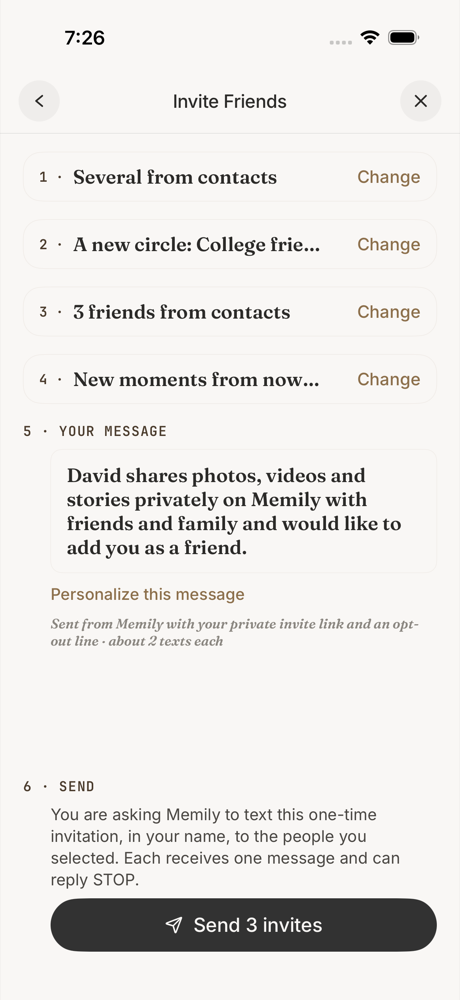
Sample message (Path 1)
Path 2 — Activity notifications, opted into by the account holder
A Memily account holder opens Settings → Notifications, verifies their mobile number by entering a one-time code, and turns on text messages for the categories they choose. Text messages are off by default and are sent only after the account holder completes this step. The consent disclosure is shown at the point of consent, directly above the "Send code" action and again beside the SMS toggles:
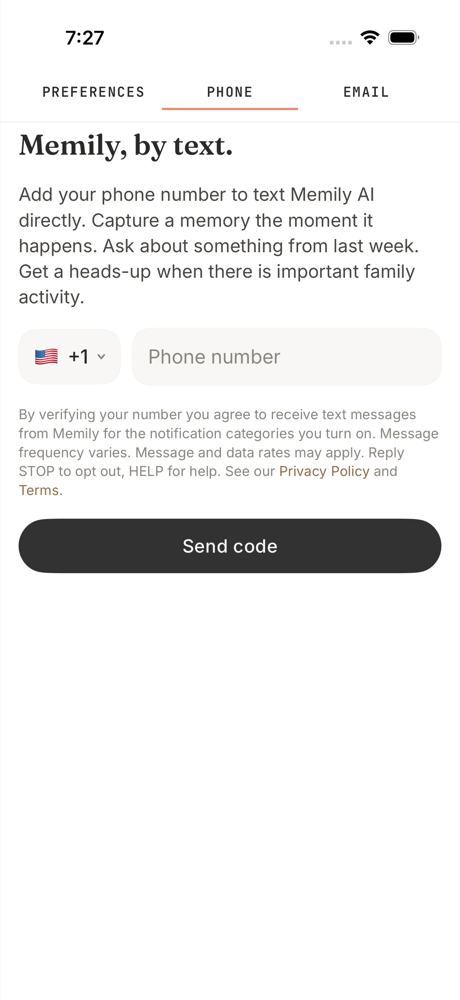
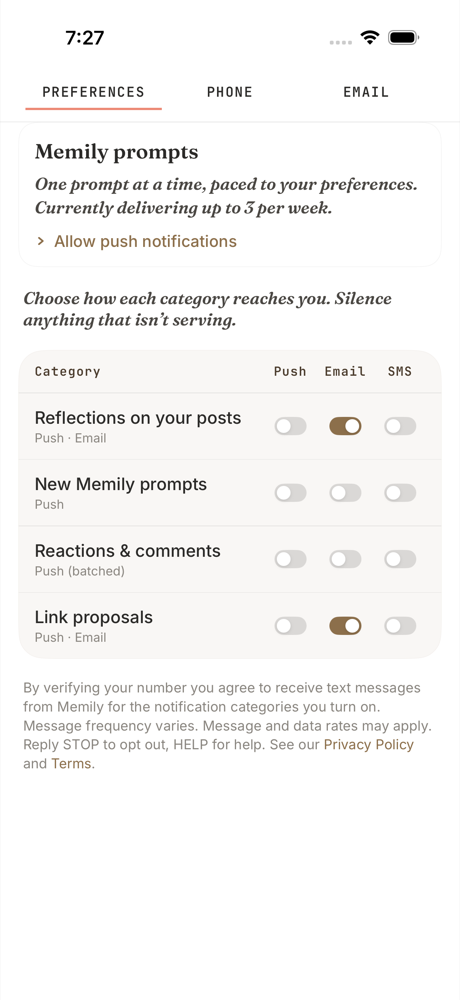
Sample message (Path 2)
Consent basis for Path 1
Path 1 messages are directed by an individual Memily user to specific people that user personally knows and selects one at a time. Memily's program is designed to the controlling rulings and industry principles for this pattern:
- FCC 14-33 (GroupMe, 2014): consent to receive an informational text may be obtained through, and conveyed by, an intermediary who knows the recipient. Order (PDF)
- FCC 15-72 (TextMe, 2015): when the app user decides whether to send an invitation, to whom, and when, the user, not the app, is the initiator of the message. Memily's user chooses each recipient individually and taps Send; nothing is preselected and there is no "select all". Order (PDF)
- CTIA Messaging Principles and Best Practices (May 2023): §4.1 describes messaging "chosen at the direction of the Consumer to a limited number of unique Consumer recipients"; §5.1.1 notes the call to action "for a single-message program can be simple". Principles (PDF)
Program safeguards: one message per recipient per invitation; the inviting user is named in the message; one branded link; STOP honored on the first reply and suppressed permanently; per-recipient, per-batch, and per-day limits enforced by the application; no incentives are offered for inviting.
Disclosures
- Program name and sender: Memily, sent by Memily, Inc.
- Message frequency: varies. Invitation texts are one-time messages sent at the direction of the Memily user who invited you; notification texts are event-driven.
- Message and data rates may apply.
- Opt out: reply STOP to any message. You will receive one confirmation and nothing further.
- Help: reply HELP to any message, or email support@memily.com.
- Privacy: mobile phone numbers and SMS consent are not shared with or sold to third parties for their marketing purposes. See the Privacy Policy and Terms of Service.